WordPress development retainer packages for agencies
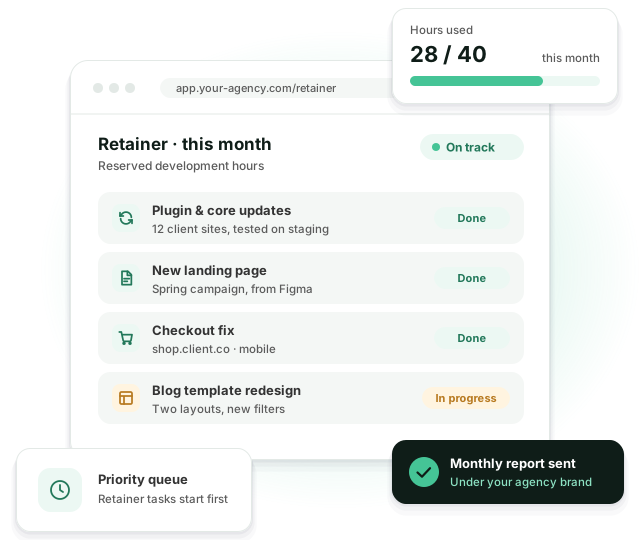
A WordPress development retainer reserves 5, 15 or 30 hours of developer time for your agency every month, with priority over ad-hoc work.
The same developers stay on your clients’ sites month after month. Nobody starts from zero when a new request comes in.
What ad-hoc development costs you
-
 Development costs are hard to predict
-
 Your tasks wait behind other clients’ work
-
 Every small job needs a new quote
-
 A new developer has to learn each site again
-
 There’s no capacity when a big project lands
-
 Deadlines slip when developers are busy
With a retainer, WordPress development becomes a fixed line in your budget.
What a retainer includes
Anything WordPress fits inside the agreed hours, across all your clients’ sites.
Reserved hours
A fixed block of development time set aside for your agency every month.
Priority
Retainer tasks start before ad-hoc work.
Any WordPress task
Pages, features, fixes, updates, WooCommerce and performance work.
Updates
Core, theme and plugin updates tested on staging, with a backup before every change.
Monthly report
Tasks done and hours used, ready to share with your clients.
The same team
The developer who fixed last month’s bug still remembers why it happened.
Who a retainer works best for
A retainer pays off when WordPress work arrives every month, even if each task is small.
- You look after 5 or more client sites and change requests come in every week
- You sell care plans to clients and need someone to deliver the work behind them
- Your in-house developer is fully booked
- You’re tired of writing a new quote for every two-hour job
WordPress development retainer sizes
Pick the size that matches a normal month for your agency. You can move up or down later. Pricing is on request.
Retainer or on-demand?
It comes down to how predictable your WordPress work is.
| Retainer | On-demand | |
|---|---|---|
| How you pay | A fixed number of hours each month | Per task |
| Priority | Ahead of ad-hoc work | Scheduled when a developer is free |
| Who works on your sites | The same developers every month | Available developers on our team |
| Budgeting | Same cost every month | Changes with the workload |
| Best for | Steady monthly work across several clients | Occasional tasks and one-off fixes |
Response times
The same on every retainer size.
Within a few hours
You get a reply to a new task within a few hours during our working day, with questions or an estimate.
Within 24 working hours
Work on non-critical tasks starts within 24 working hours. Bigger tasks get a plan first.
Urgent issues first
A site that’s down or a checkout that’s broken goes to the top of the list, ahead of planned work.
How a retainer runs
-
1. Agree on hours
We look at your last few months of WordPress work and agree on a size, response times and how you want tasks sent.
-
2. Send tasks any time
In Slack, email, ClickUp, Asana or your own system. We confirm each task, ask what’s unclear and work through them by priority.
-
3. Read the report
At the end of each month you get every task with the time it took, ready to forward to your clients or to bill them.
Example: a month on a 15-hour retainer
A typical month for an agency with six client sites. Total: 14.5 of 15 hours, with every task and its time listed in the monthly report.
Updates: 2.5 hours
Core and plugin updates on six sites, tested on staging. One plugin conflict caught and fixed before it reached a live site.
New landing page: 5 hours
Built from the agency’s Figma file with the site’s existing blocks, plus one new testimonial block.
WooCommerce fix: 2 hours
Shipping rates for one region were wrong after a plugin update. Found the cause, fixed it, added a note to the report.
Speed work: 2.5 hours
Oversized images, missing lazy loading and a heavy slider replaced on one client’s home page.
Forms and CRM: 1.5 hours
Contact form leads sent to HubSpot with UTM fields, so the client can see which campaign they came from.
Small edits: 1 hour
Menu changes, a new team member, footer text and a cookie banner tweak.
Retainer FAQ
Three months. After that you can cancel with 30 days’ notice.
Yes. Move between 5, 15 and 30 hours as your workload changes, starting from the next month.
No. The hours are developer time reserved for your agency. In a quiet month we can pull planned work forward, such as updates, audits or small improvements.
Yes. If your work is irregular, on-demand development with pay-as-you-go pricing may fit better.
Yes. Reports come with your logo or with no branding at all.
Related services
Related reading
Want a WordPress team on call every month?
Tell us roughly how much work you have. We’ll suggest a retainer size.