Custom WordPress plugin development for agencies
Custom WordPress plugin development for the features no plugin does well, built to WordPress coding standards and handed over under your brand.
Secure, documented and safe to update. The plugin header carries your agency’s name, and the code belongs to you once it’s paid for.
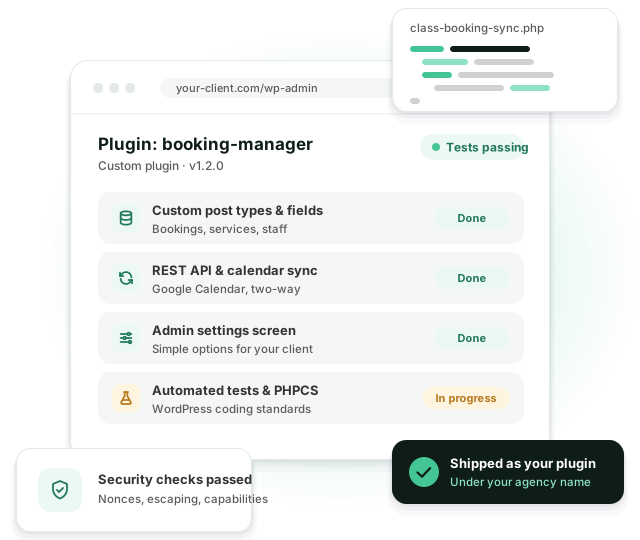
When off-the-shelf plugins stop working for you
-
 The client needs a feature no plugin offers
-
 Five plugins for one feature slow the site down
-
 Premium plugins add yearly license costs
-
 An abandoned plugin turns into a security risk
-
 Customizations break when the plugin updates
-
 Nobody on your team writes backend PHP
Build it once, build it properly, and let your client own it.
Premium plugin or custom plugin?
Often a premium plugin is the right call, and we’ll tell you when it is. When it isn’t, this is usually why. More on that in when to build a custom WordPress plugin.
| Premium plugin | Custom plugin | |
|---|---|---|
| Fit | Close, with workarounds | Does exactly what the client needs |
| Cost over time | Yearly license | Paid once |
| Code loaded | Every feature, used or not | Only what the site uses |
| Updates | Can break your customizations | Under your control |
What we build
Small helper plugins, and the larger ones with real business logic.
Custom features
Booking systems, calculators, member areas, directories: features built for one business.
Plugin extensions
Add-ons for WooCommerce, Gravity Forms, ACF and others, without touching their core files.
Integrations
WordPress connected to CRMs, ERPs, payment providers and external data.
Admin tools
Custom post types, admin screens and settings your clients can find their way around.
Plugins we build for agencies
A few typical requests from the last couple of years.
Quote calculator
A manufacturer’s price logic (sizes, materials, volume discounts) turned into a calculator that emails a PDF quote and creates a CRM deal.
Member directory
Profiles members edit themselves, with search, filters and a map. Admins approve changes before they go live.
B2B pricing for WooCommerce
Customer-specific price lists, minimum order quantities and invoice payment for approved accounts.
Event importer
Events pulled nightly from a ticketing API, with images, venues and sold-out status kept in sync.
Approval workflow
A Gravity Forms add-on that routes requests through two approval steps and logs every decision.
Small helpers
Custom post types, shortcodes, admin columns and the scattered snippets that shouldn’t live in functions.php.
How big a custom plugin usually is
We don’t publish prices, but hours are a fair guide. You get a fixed quote after the spec.
| Typical hours | Examples | |
|---|---|---|
| Small helper | 4–10 hours | Custom post type, shortcode, admin tweaks |
| Extension of an existing plugin | 8–25 hours | WooCommerce, Gravity Forms or ACF add-on |
| External API integration | 15–40 hours | CRM, ERP or ticketing sync |
| Business logic with admin screens | 40–120 hours | Calculators, directories, booking, B2B pricing |
Code and security standards
The checklist every plugin goes through before handover. It’s also what we look for when an agency asks us to review a plugin someone else wrote.
- WordPress Coding Standards, checked with PHPCS
- Nonces and capability checks on every form and AJAX call
- Input sanitized, output escaped, SQL through $wpdb->prepare()
- No direct file access, no secrets in the code
- Translation-ready strings and a clean uninstall
- Tested on the current WordPress and PHP 8.x
How custom WordPress plugin development works
-
1. Write the spec
Tell us what the feature should do. We write a short technical spec and send a fixed quote.
-
2. Build and test
We develop on staging, check the code with PHPCS and test it with the site’s theme and plugins.
-
3. Hand over
The plugin ships with your agency’s name in the header, a readme and code comments, ready to install on the client site.
-
4. Support
Bugs found in the first 30 days are fixed at no extra cost. After that, a retainer or on-demand hours keep the plugin current with new WordPress and PHP versions.
What you get at handover
Everything another developer would need to take over the plugin without calling us.
The code
A Git repository or a zip, whichever fits your workflow, with your agency’s name in the plugin header.
A readme
How to install and configure it, which hooks it adds and which settings matter.
Notes for the client
A short guide to the admin screens, written for the people who will use them, not for developers.
A changelog
What changed in each version, so updates on the client site are never a guess.
Example: a quote calculator for a manufacturer
A typical mid-sized plugin for a design agency’s industrial client.
-
Before
Sales staff priced every custom order in a spreadsheet. Website visitors had to email and wait a day for a number.
-
Spec
Sizes, three materials, volume discounts and a minimum order value. One page of rules, signed off by the client’s sales lead.
-
Build
About 70 hours: the calculator, a PDF quote by email, a HubSpot deal for each quote, and an admin screen where sales staff update prices themselves.
-
After launch
One rounding bug in week two, fixed under the 30-day period. Price changes since then are made by the client’s team, without a developer.
Plugin development FAQ
Your agency does. Once the project is paid, the code is yours to use and hand over to your client.
Yes. If it has hooks or an API, extending it is often faster and cheaper than writing a new one.
We build on WordPress APIs and hooks and test against current versions. Bugs in the first 30 days are on us. After that, a retainer keeps the plugin up to date with new WordPress and PHP releases.
Yes. We can prepare it for the WordPress.org guidelines if you want to release it publicly.
Yes. The plugin header, the readme and the admin screens use your agency’s name, not ours.
Related services
Have a feature in mind for a client?
Describe what it should do. We’ll come back with a short spec, a timeline and a quote.