White Label Partner vs Freelancer vs In-House Developer: What’s Best for Your Agency?
“White label vs freelancer” is usually the first version of the question. Then someone on the team adds “or should we just hire?” We sell one of these options, so read this knowing that. We’ll try to be straight about when the other two are the better choice, because a partner who gets a bad-fit client gets a short, unhappy project.
Start small if you’re unsure. Our on-demand WordPress development exists partly for agencies that want to test a partner on a single task before deciding anything.
The three options at a glance
An in-house developer is on your payroll. You pay for their time whether there’s work or not, and in return you get their full attention and a person who knows your clients by name.
A freelancer is one independent person you hire per task or per project. They’re flexible, often very good, and they have other clients.
A white label partner is a company that does the work under your brand. You usually get a team with a process around it, in exchange for a higher hourly rate and a bit less direct control.
True cost of an in-house developer
The salary is the number everyone looks at, and it’s only about 70% of what you’re paying.
Here’s a calculation for a US web developer, based on public data. The Bureau of Labor Statistics puts the median annual wage for web developers at $90,930 (May 2024). Its Employer Costs for Employee Compensation release shows that benefits make up 30% of total compensation for private industry workers (June 2026). Your numbers will differ by city and seniority, but they make a fair starting point.
| Item | Amount | Note |
|---|---|---|
| Median salary | $90,930 | BLS, web developers |
| Benefits and payroll costs | $38,970 | 30% of total compensation |
| Total compensation | $129,900 | Before recruiting and tools |
| Working hours in a year | 1,880 | 2,080 minus 25 days of holidays and PTO |
| Billable share (our assumption) | 70% | Meetings, admin, training, slow weeks |
| Billable hours | 1,316 | 1,880 × 0.70 |
| Cost per billable hour | About $99 | $129,900 ÷ 1,316 |
And that leaves out recruiting, which often means a fee or weeks of your own time; a laptop and software licenses; the ACF Pro, staging and tool subscriptions; and the management time a junior or mid-level hire needs. If your billable share drops to 50% in a slow quarter, the cost per billable hour climbs to about $138.
That doesn’t make hiring a bad idea. An in-house developer gives you things no partner can match: they sit in your kickoff calls, they learn how your strategist thinks, and they make your agency more valuable if you ever sell it. It only makes financial sense when you have enough work to keep them busy, though. One person also means one point of failure. Holidays, sick days and resignations all land on you.
Freelancers: flexibility vs risk
We’ve got nothing against freelancers. Oleh, our founder, has a Top Rated Plus profile on Upwork, and some of the sharpest WordPress developers we know work alone. For a small agency with occasional work, a good freelancer is often the right answer.
The upside is obvious. There’s no commitment, the hourly rate tends to be lower than a company’s, and you speak directly to the person writing the code. Work comes back without passing through anyone else.
The problems are structural rather than personal:
- A freelancer’s capacity is one person. If they take a big project, your small urgent fix waits. You can’t scale up for a busy month.
- Nobody covers when they’re sick, on vacation or gone. If they disappear mid-project, you may be left without the repo, the staging logins or an explanation of how things were built.
- QA is usually self-review. That’s not laziness. It’s just hard to find your own bugs, and it’s why you end up doing the testing yourself.
- Project management stays with you. You write the briefs, chase the deadlines and answer the questions.
Most of this can be managed. Keep code in your own Git repository, hold your own logins, pay per milestone, and find a second freelancer before you need one. But each of those is an extra job for your agency. They’re the hidden cost of a low hourly rate.
White label partner: process, QA and capacity
What you buy from a partner is the things around the code. Someone to reply when your usual developer is out. A second person checking the work before it reaches you. Enough people that a busy month doesn’t break the schedule. An NDA, and a way of working that keeps your client from ever seeing another company’s name.
For a task-based setup, here’s what ours looks like: the minimum order is one hour, we track time in 15-minute steps, and non-critical work starts within 24 working hours. Other partners will differ, but ask for this level of detail. Our 12 questions for choosing a white label partner will help you compare them.
There are real downsides, and we’d rather you hear them from us:
- The rate is higher than a freelancer’s, because you’re paying for that overhead.
- Communication passes through more people unless you insist on a direct line to the developer. Insist.
- A partner has other clients, too. You have priority only if you’ve paid for it, through a retainer or a dedicated developer.
- A weak partner is worse than a good freelancer. Plenty of agencies sell a junior team behind a good sales process, and the quality varies a lot.
- Your developers will never pick up your agency’s unwritten habits the way a staff member does, so you need to write them down.
The fix for the last two is to test before you commit. Send a real task from your backlog, not a made-up exercise, and see what comes back and how the conversation goes.
Want to test us on real work? Your first on-demand task, up to 2 hours, is free. No contract, no deposit.
White label vs freelancer vs in-house: comparison table
| Criteria | In-house | Freelancer | White label partner |
|---|---|---|---|
| Cost when there’s no work | Full salary | None | None on task-based, reserved hours on a retainer |
| Time to start | Often 1 to 3 months to hire | Days | Days, or 5 to 7 working days for a dedicated developer with us |
| Risk of disappearing | Low, but people resign | Highest | Low, the team covers |
| QA | Depends on your team | Usually self-review | Should be built in, so ask how |
| Capacity for a busy month | Fixed | One person | Can add people |
| Range of skills | One person’s | One person’s | Several people’s |
| NDA and invisibility | Not a concern | Case by case | Standard, ask for it in writing |
| Your management time | High at first, then medium | High | Lower once the process is set |
| Knowledge of your agency | Best | Grows if they stay | Grows, but needs documenting |
Run this with your own numbers
Generic comparisons only get you so far, and yours will take about an hour. Pull your last 12 months of invoices and count the WordPress hours you paid for, month by month. Then count your team’s time around them: briefs, chasing, testing, fixing, client apologies. Most agencies never count that second number, and it’s often the one that settles the question.
Divide your yearly hours by the 1,316 billable hours above. If the result is below 0.5, a full-time hire would sit idle for much of the year. Near 1 and steady, a hire deserves a serious look. Between those, a partner or a part-time arrangement usually costs less. Look at the months as well as the total, because 800 hours in four busy months is a very different problem from 800 hours spread evenly.
Which model fits which agency stage
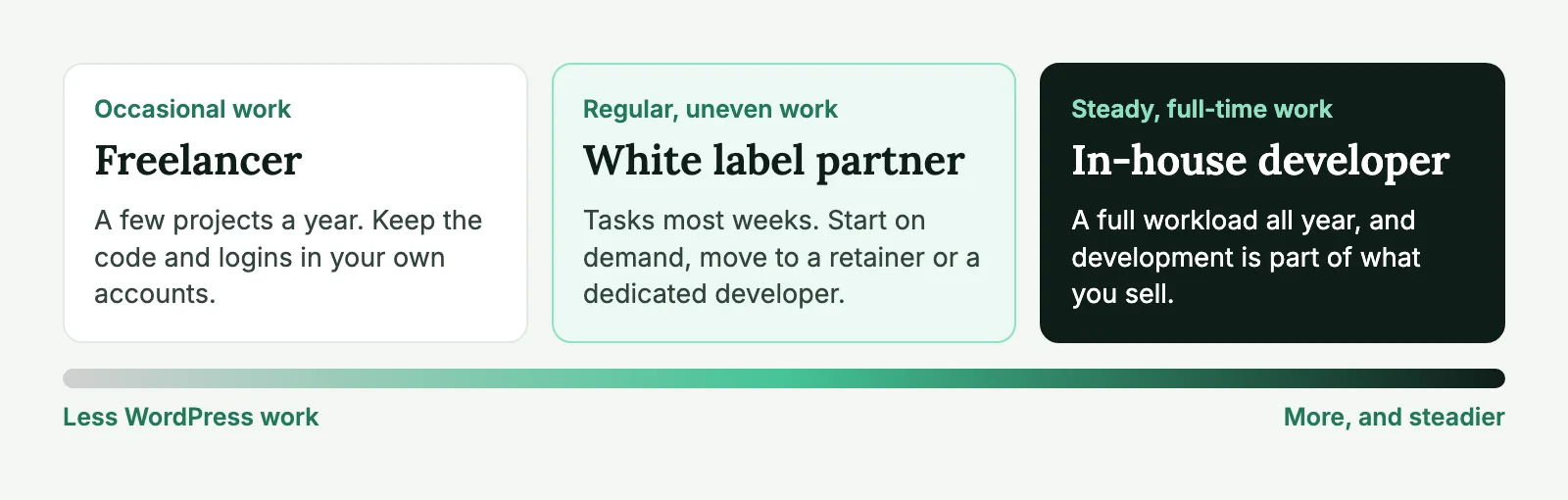
Up to a few WordPress projects a year? Use a freelancer, or a partner on a per-task basis. You don’t have enough work for anything else, and a monthly commitment would sit unused. Do keep ownership of the code and the logins.
If WordPress work comes in most weeks, but unevenly, this is where white label usually fits best. You have too many deadlines to depend on one freelancer and too little predictable work for a salary. Begin with on-demand tasks. Once the work is coming in every week, a retainer gives you reserved time. Agencies with a lot of resold WordPress work often end up here, because they need capacity that moves with their sales.
When there’s enough work to fill a person, but you’re not sure it’ll last, a dedicated developer from a partner is a useful middle step. You get one person on your projects full time or part time, about 20 or 40 hours a week, and you can stop with 30 days’ notice. If the work holds up after six months or a year, you’ll know a hire is safe.
Steady full-time work, with development as part of what you sell? Hire. Keep architecture, technical decisions and your biggest accounts in-house. A partner can still pick up overflow, maintenance and specialist work, and that also covers you for the holidays and for the day your developer hands in their notice.
There’s also a case against all three, which is worth a sentence. If WordPress work is a tiny part of what you do and it’s mostly updates, it might be cheaper to refer it to someone and take a commission.
If you’re at the second stage and want to see how a partner works, send us a task from your backlog. We’ll send an estimate in hours, and if it’s your first task and it fits in 2 hours, it’s free.
Hiring options FAQ
Per hour, often yes. Per delivered project, not necessarily, because the rate usually includes QA, project management and cover for absences that you would otherwise handle yourself. Compare the total cost of a finished project, including your own team’s time.
Not if it’s set up properly. A partner works under NDA, uses your email domain or stays behind your project manager, and removes its name from code comments, reports and admin screens. Ask how they handle each of those.
When you have steady work for one person, month after month, and you need that person in internal meetings. Agencies usually reach that point once WordPress work reliably fills most of a developer’s week for six months or more.
Yes, and most agencies with a developer on staff do. The in-house developer keeps architecture and the big accounts, and a partner handles overflow, maintenance and the skills your developer doesn’t have.