Dedicated Developer vs Project-Based Outsourcing: Which Model Fits Your Agency?
The dedicated developer vs project-based question usually comes up after the third rush job in a month. You’ve been sending tasks to an outsourced team one quote at a time, and you start wondering whether it would be cheaper and calmer to have one developer who is simply yours. Sometimes it is. Sometimes you’d be paying for a person to wait for your next brief.
We run all three models for agencies: project-based or on-demand development billed per task, retainers with reserved hours, and a dedicated WordPress developer who works only on your projects. This article compares them on cost, control and risk, and shows how to find your own break-even point in hours.
How each model works
Project-based outsourcing
You send a brief, get an estimate, approve it, and the work gets done. Each project or task has its own scope and its own price, fixed or hourly. Between projects you pay nothing.
Fixed-price projects suit well-defined work: a new site from Figma, a plugin with a clear spec. On-demand work suits the stream of smaller jobs agencies get every week: a new landing page, a broken form, a WooCommerce tweak. With us, on-demand has a 1-hour minimum and time is tracked per task in 15-minute steps.
Retainer
You reserve a block of hours every month (5, 15 or 30 with us). Your tasks get priority over ad-hoc work, small jobs don’t need a separate quote, and the same people work on your sites. The minimum term is three months.
Dedicated developer
You reserve a developer’s time for a month: part-time (about 20 hours a week) or full-time (40). The developer works only on your tasks, joins your Slack or Teams and learns your clients’ sites. You set the priorities day to day, and you pay for the reserved time whether you fill it or not. A dedicated developer starts within 5 to 7 working days; the minimum is one month, then 30 days’ notice.
Dedicated developer vs project-based vs retainer
| Project-based / on-demand | Retainer | Dedicated developer | |
|---|---|---|---|
| You pay for | Hours or scope delivered | 5, 15 or 30 reserved hours a month | ~86 or ~173 reserved hours a month |
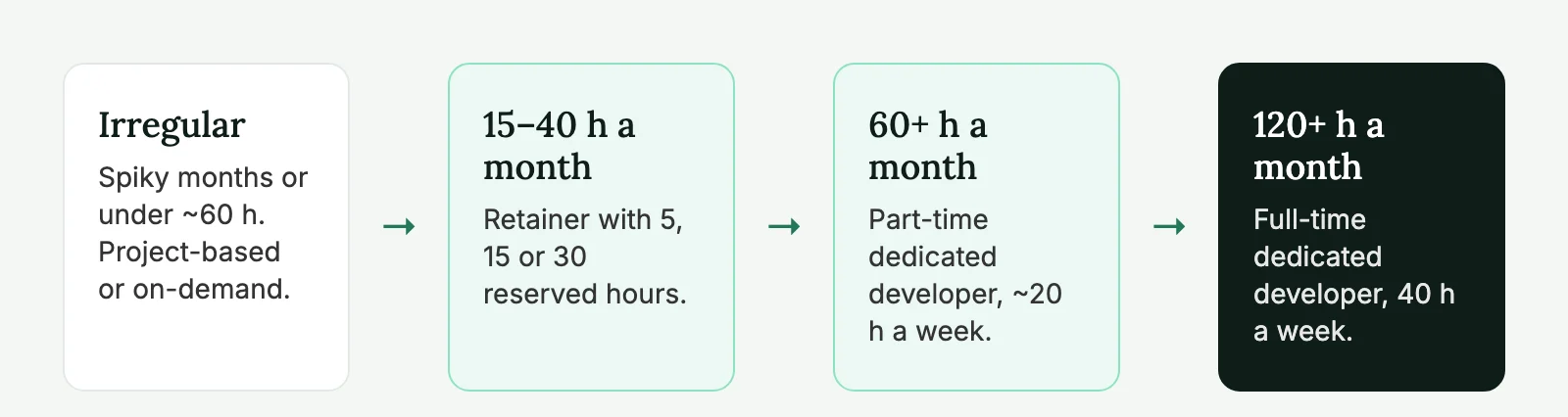
| Best workload | Irregular, spiky | Regular, 15–40 hours a month | Steady, 60+ hours a month |
| Start time | Days, per project | Within a week, then priority | 5–7 working days once |
| Who sets priorities | Each quote | You, within the hours | You, every day |
| Context about your sites | Rebuilt per project | Kept by the same small team | Grows every month |
| Communication | PM or tickets | PM, shared task board | Direct, in your chat |
| Budget risk | Overruns on vague scope | Unused hours | Idle time in quiet weeks |
| Commitment | None | 3 months | 1 month, then 30 days’ notice |
Find your break-even point
We don’t publish rates, so let’s use a formula you can fill in with your own quotes. A dedicated developer costs the reserved hours times the dedicated rate. Project work costs the hours you actually need times the project rate, plus overhead: the buffer in fixed quotes (often 15 to 20%) and the time lost to estimating and getting into context on each new task.
break-even hours = reserved hours × dedicated rate ÷ (project rate × (1 + overhead))Example with assumed numbers: a dedicated rate 20% below the project rate and 15% overhead on project work. A part-time developer (about 86 hours a month) then breaks even at 86 × 0.8 ÷ 1.15 ≈ 60 hours of real development a month. A full-time developer breaks even at about 120.
Those 60 and 120 hours are the result of the assumptions, not a rule. If the gap between the two rates in your quotes is 10%, part-time breaks even closer to 67 hours. If your project work carries more overhead, because tasks are small and context switching eats time, it drops toward 50. Put your real numbers in.
A worked example: an agency with 3–5 projects a month
Example: a design agency with 12 retainer clients and 3 to 5 new projects a month. Here’s a typical month of WordPress work.
| Work | Hours |
|---|---|
| Two landing pages from Figma | 32 |
| One 8-template site, first half of the build | 40 |
| WooCommerce changes for one client | 14 |
| Updates and checks on 12 maintained sites | 12 |
| Small change requests (forms, content blocks, fixes) | 16 |
| Total | 114 |
With the same assumed rates (project rate = 1.0, retainer 15% lower, dedicated 20% lower, 15% overhead on project work), the month costs:
- All project-based: 114 × 1.15 ≈ 131 units.
- A 30-hour retainer for maintenance and small changes, the rest project-based: 30 × 0.85 + 84 × 1.15 ≈ 122 units.
- A part-time dedicated developer for the steady work, with the overflow as project work: 86 × 0.8 + 28 × 1.15 ≈ 101 units.
- A full-time dedicated developer: 173 × 0.8 ≈ 138 units, with about 60 hours a month unused.
For this agency, part-time dedicated plus project work for the launches is the cheapest mix, about 23% below the all-project option. Full-time costs more than everything else until the workload grows past roughly 120 hours a month, every month.
The catch is the word “every”. If you have 114 hours in March and 30 in April, April still costs you the full reserved time. Look at the quietest month in the last six, not the average.
A smaller agency: 2–3 steady clients
Now take an agency with two or three clients on care plans and a new site every couple of months. WordPress work runs between 10 and 35 hours a month, with no pattern. A dedicated developer would sit idle half the time. Here, on-demand work for the builds and a 15-hour retainer for the steady clients is the right setup. The retainer buys priority and continuity, and the builds are quoted one by one.
That agency should move to a dedicated developer only when the quietest month goes over 60 hours. Most never need to.
The risks of a dedicated developer, and how we handle them
One person on your projects is also one point of failure. These are the questions agencies ask before they sign, with how we handle each one.
Vacations. Planned leave is agreed at least two weeks ahead and shown in your shared calendar. A second developer who has already done small tasks on your projects covers anything urgent, and days your developer is away aren’t billed.
Sick days. The same backup developer picks up critical tasks from the next working day. For a longer absence, we either extend the backup’s hours or pause the reserved time.
No tasks this week. Ask your developer to work through a “when there’s nothing else” list: plugin updates on older sites, tech debt, documentation, accessibility fixes. Agencies that keep that list rarely feel they’re paying for idle time. If quiet weeks become quiet months, switch to a retainer.
The developer leaves or isn’t a good fit. We replace them within 5 working days, free of charge, with a handover of open tasks and notes from the previous developer.
Knowledge stuck in one head. Site credentials, deployment notes and client quirks live in your password manager and wiki, not in your developer’s memory. We ask for that from day one, so a replacement doesn’t start from zero.
How working with a dedicated developer looks in practice
Tasks come from your tracker: Jira, Asana, ClickUp or Trello, whichever you use. Your developer posts a short written update in your chat every morning: what was done yesterday, what’s next, what’s blocked. Once a week there’s a 30-minute call with your PM to set priorities for the next week.
Quality doesn’t depend on one person. Every pull request is reviewed by a senior developer on our side before it reaches your staging site, and your team reviews the result on staging before anything goes live. At the end of the month you get a report of hours by client and project, which makes it easy to bill your own clients.
Not sure your workload is steady enough? Send us your last six months of WordPress tasks and we’ll tell you which setup makes sense, including whether you need a dedicated developer at all.
Switching between models
You don’t have to pick once. The usual path is on-demand tasks to test quality, a retainer when the work becomes regular, and a dedicated developer once the retainer runs out every month. When a big client leaves, go back a step.
A few things make switching painless:
- Keep documentation in your own tools, not in a developer’s head.
- Ask for the same people. When you move from project work to dedicated, ask for a developer who already worked on your sites. With us that’s the default when possible.
- Plan the notice period. A dedicated developer needs 30 days’ notice. If you know a quiet quarter is coming, give notice early and use the last month to finish open tasks.
- Keep project-based work for spikes. A dedicated developer handles the base load; a launch with a hard deadline can still go to a project team on top of it.
We compare all three options with hiring in-house in white label partner vs freelancer vs in-house developer, and the retainer math in more detail in retainer vs hourly billing.
Which one to choose
Count real development hours per month for the last six months. If the quietest month is above your break-even point and someone on your team can manage a developer, try part-time dedicated. If your months swing between 10 and 80 hours, take a retainer for the base and quote the spikes. And if you can’t tell, start small: send one task (the first one, up to 2 hours, is free), see how it goes, and decide on the model after you’ve seen the work. Get in touch and tell us what your month usually looks like.
Dedicated vs project-based FAQ
Only when you keep them busy. With a dedicated rate 20% below the project rate and 15% overhead on project work, a part-time dedicated developer breaks even at about 60 hours of real development a month and a full-time one at about 120. Plug in your own rates, because the break-even point moves with them.
Planned leave is agreed at least two weeks ahead and those days aren’t billed. A backup developer who already knows your projects covers urgent tasks during leave and from the next working day when someone is sick.
We replace them for free within 5 working days, and the previous developer hands over open tasks and notes, so the new one doesn’t start from zero.
If your WordPress work is under about 60 hours a month or swings a lot, a retainer for steady clients plus on-demand work for builds costs less. Move to a dedicated developer when even your quietest month is above your break-even point.
For a dedicated developer, one month, then cancellation with 30 days’ notice. Retainers have a three-month minimum. On-demand work has a 1-hour minimum and no monthly commitment.