How to Get a WordPress Site Cited by ChatGPT, Perplexity and Google AI Overviews
Most advice on how to get cited by ChatGPT, Perplexity and Google’s AI Overviews is written from the outside: here’s what the models probably like, here are ten tips. We wanted to see what actually happens on WordPress sites. So on November 16 we checked 33 white label WordPress agency sites, the kind of sites our readers run, and went through a month of our own server logs to see which AI systems read deviart.agency and what they asked for.
Some of what we found matched the usual advice. Some of it didn’t. The short version: robots.txt is almost never what keeps a WordPress site out of AI answers, llms.txt is everywhere and read by nobody, and the gaps that do matter are less exciting. They’re in the HTML, the schema and the firewall.
This is the research behind our AI search optimization for WordPress service, written up so you can run the same checks on client sites.
What we checked
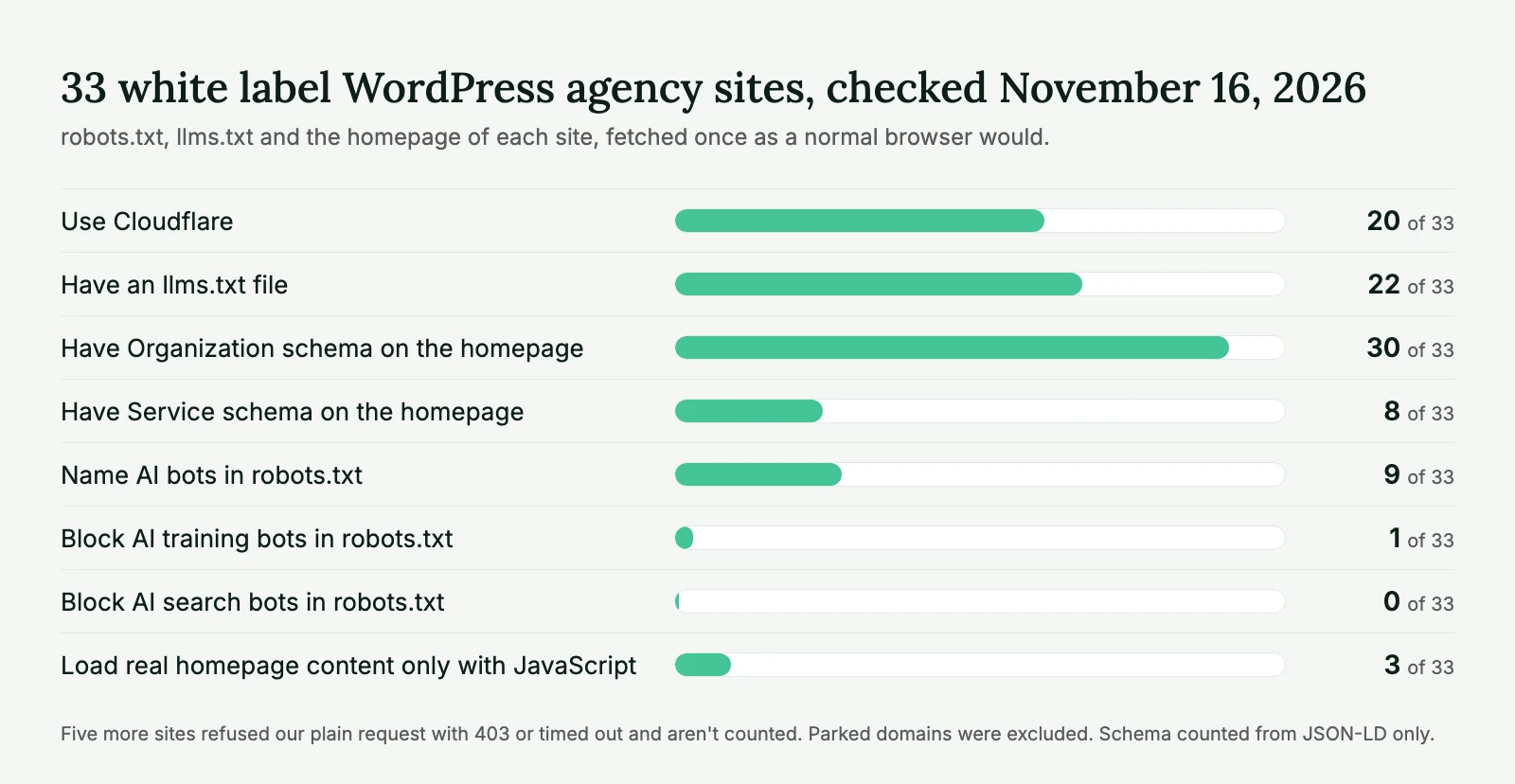
For each of the 33 sites we fetched three things once, with a normal browser user agent: /robots.txt, /llms.txt and the homepage. We parsed robots.txt for the AI crawlers, read the JSON-LD schema on the homepage, and compared the text in the raw HTML with the text after a headless Chrome had run the page’s JavaScript. Five more sites refused even that single plain request with a 403 or timed out, so they aren’t in the numbers. Parked domains were left out.
We don’t name the sites. Some of them are competitors, and the point is the pattern, not who got what wrong.
robots.txt is almost never the problem
Not one of the 33 sites blocked an AI search crawler (OAI-SearchBot, Claude-SearchBot, PerplexityBot) in robots.txt. One blocked the training crawlers (GPTBot, ClaudeBot, Google-Extended and others) and left search bots alone, which is exactly the setup we’d recommend to a client who wants out of training. Nine named AI bots in their file, almost all to allow them explicitly.
That matches our own logs. Real OAI-SearchBot visited deviart.agency 99 times in 31 days and got a 200 or a redirect every time. Real GPTBot came 111 times, mostly to read the sitemap.
What robots.txt doesn’t show is the layer in front of WordPress. Twenty of the 33 sites run behind Cloudflare, which can block AI crawlers before a request reaches the server. On our own site, not a single request from Perplexity’s published IP ranges arrived in a month, though our robots.txt allows PerplexityBot. We’re still tracking down why. And the five sites that blocked our plain request show how strict some bot protection is.
So test access from outside, and then confirm it in the logs. This tells you whether the server answers a request that claims to be OAI-SearchBot:
curl -s -o /dev/null -w "%{http_code}\n" -A "Mozilla/5.0 AppleWebKit/537.36 (KHTML, like Gecko); compatible; OAI-SearchBot/1.3; +https://openai.com/searchbot" https://client-site.com/services/A 403 or 503 means something blocks the name. A 200 proves less than it seems, because Cloudflare can treat the real bot’s IPs differently from yours. The logs are the real test, and they need care: about a third of the “OpenAI” requests in ours came from other IPs, mostly scanners. We explain how to separate them in AI crawlers and robots.txt on WordPress.
Some of the text isn’t in the HTML
AI crawlers read the HTML the server sends. Most don’t run JavaScript the way a browser does.
On first count, five of the 33 homepages had roughly twice as many words after JavaScript ran, one of them almost three times. Then we looked at what those words were. On two sites it was cookie consent text and an accessibility toolbar. On the other three it was real content: a case studies section, a row of results figures, and service descriptions (plus, on one, a full country list for a phone number field). A crawler that doesn’t run scripts never sees those parts.
Three out of 33 isn’t many, and these are developer-run sites. We expected page builders to be worse, so we tested Elementor, Kadence and Spectra on a clean install. Their tabs, accordions and sliders kept all their text in the HTML. Their counters didn’t: the numbers only appear after JavaScript runs. The details and a fix are in AI crawlers and JavaScript: our page builder test.
The check takes a minute. Open the page source (not the inspector) and search for a sentence from the part you care about. Or from the terminal:
curl -s https://client-site.com/services/ | grep -c "a sentence from the page"Zero means the sentence isn’t in the HTML. Our own pages, for comparison, have the same word count before and after JavaScript, because the theme renders everything on the server.
Service pages say less than the homepage
Thirty of the 33 homepages had Organization schema, which is what Yoast and Rank Math output by default. Only eight had any Service schema, and nine had FAQPage.
That’s the gap we’d close first on a client site. Organization tells a machine the company exists. It doesn’t say what the company sells, to whom, or where. When someone asks an assistant for “a white label WooCommerce developer for agencies”, Service schema on the WooCommerce page, linked to the Organization, is one of the few signals that spells it out without guesswork.
On WordPress we extend the Yoast or Rank Math graph instead of pasting separate JSON-LD that contradicts it:
- Organization with
sameAslinks to LinkedIn, Clutch, Google Business Profile and other official profiles. - Service on each service page, with
providerpointing to the Organization. - Article with a real Person as author, with a bio and profile links.
- FAQPage only where the questions are real and the answers are visible.
Validate with the Schema Markup Validator after every change. Broken schema is worse than none.
Want the same checks on a client site? Our free AI readiness audit covers bot access in the logs, the raw HTML and the schema, and comes back as a report you can forward under your agency’s name.
Write passages that can be quoted
This part is for your writers. AI answers quote short passages, usually one to three sentences. A page gets quoted when one of its sentences answers a question on its own.
Example, not a real client. A typical service page opens like this:
“At Acme Engineering, we believe every project deserves care. Since 1998 our passionate team has delivered innovative solutions to clients across the region.”
Nothing in it answers a question. Compare:
“Acme Engineering designs HVAC systems for commercial buildings between 5,000 and 200,000 sq ft in Ohio and Indiana. Most projects take 6 to 10 weeks from survey to drawings.”
That one answers “who designs HVAC for office buildings in Ohio” in one passage. Put the answer in the first sentences under each heading, use real numbers, and turn comparisons into tables. Good web copy always looked like this. AI search is just less forgiving when it doesn’t.
What AI assistants actually opened on our site
The most useful number in our logs was the smallest. ChatGPT-User, the agent that opens a page because a person asked ChatGPT to, made 27 real requests in 31 days. Most went to the homepage. Nine minutes after we published our AI search pages, it fetched all three in the same second, because someone pasted the links into ChatGPT.
When people ask an assistant about a company, it opens the homepage first. So the homepage has to say plainly, in the HTML, who the company is, what it does and for whom. User fetches are also rare. One of them is a real person looking at you right now, which makes it worth more than a hundred crawler visits.
What still comes from classic SEO
AI search leans on search indexes, so a lot of it is still plain SEO done properly:
- Google indexing. AI Overviews and AI Mode only use pages that are indexed and allowed to show a snippet. A stray
noindexornosnippetremoves a page from both. - Bing indexing. Copilot answers come from Bing. Verify the site in Bing Webmaster Tools and turn on IndexNow, which Yoast and Rank Math support.
- Speed. Crawlers don’t wait forever, and slow sites rank worse in the indexes AI search draws on. Our Core Web Vitals guide covers the usual fixes.
- Mentions elsewhere. Assistants lean on what directories, reviews and comparison articles say about a brand. That’s PR work, not development, but tell the client the website alone won’t carry them.
How to measure AI traffic
Referral visits. ChatGPT, Perplexity, Claude, Gemini and Copilot send visitors with a referrer. In GA4, create a custom channel group with a channel called “AI assistants” and this source regex, placed above “Referral”:
chatgpt\.com|chat\.openai\.com|perplexity\.ai|claude\.ai|gemini\.google\.com|copilot\.microsoft\.comBot visits. Count real crawler and user-fetch requests in the server logs, after filtering out the fakes. On Cloudflare, AI Crawl Control shows the same without the logs.
Google. AI Overviews and AI Mode traffic sits inside the normal “Web” numbers in Search Console. You can’t separate it, so watch queries you know trigger AI Overviews.
Our take
After 33 sites and a month of our own logs, we’d spend a client’s first few hours like this: confirm in the logs that real OpenAI, Anthropic and Perplexity crawlers get through, check that the key pages say what they need to in raw HTML, and add Service schema to every service page. Then hand the copy notes to the writers. We’d skip llms.txt and anything sold as a secret AI ranking factor. If you’d rather hand the technical part to us, send us a site.
How to get cited by ChatGPT: FAQ
Check access first: the logs should show real OAI-SearchBot requests getting a 200. On the 33 agency sites we checked, robots.txt never blocked it, so look at Cloudflare, the host’s bot protection, and whether the important text is in the raw HTML. After that it’s content and reputation: pages need passages that answer questions, and other sites need to mention the brand.
No. GPTBot collects data for model training. ChatGPT search uses OAI-SearchBot, a separate setting in robots.txt. A site can block training and still appear in ChatGPT search.
It removes guesswork about who the business is and what each page offers. Most agency sites we checked had Organization schema, but only 8 of 33 had Service schema, which is the part that says what they sell. It won’t get weak content quoted on its own.
22 of the 33 agency sites we checked have one. Ours was requested 78 times in a month, by Lighthouse, SEO tools and people, and never by an AI crawler. Google says its AI features don’t need it. It’s harmless, but it’s not where the results come from.
No. You can remove the technical reasons a site gets skipped and improve the content. Whether a model quotes it also depends on competitors and on what other sites say about the brand.